The Castle Doctrine Forums
Discuss the massively-multiplayer home defense game.
You are not logged in.
- Topics: Active | Unanswered
#351 Re: Main Forum » Motivation » 2014-01-17 18:27:02
This is a funny idea! Like Oregon Trail.
"Jeb is starving, and Ezekiel died of dysentery. RIP"
There's a hole in the bucket, dear Liza. Well fix it, dear Henry.
The problem is that there's already a huge drain on money in the game (people spend stuff on tools, and then it gets eaten when the tools are used, and parts of houses are destroyed, and then some rich guy dies and takes his fortune to the grave). So, I'd be very wary about adding another drain (I'd have to pump up bounties to compensate).
#352 Re: Main Forum » A note in response to the recent posting on steam sales » 2014-01-17 18:22:36
The game is open source and in the public domain! The full source code is out there on SourceForge, in plain public view.
So... the notion of a "pirate copy" is a strange one, because the game is free for everyone to "get" if they want to.
HOWEVER....
What you are paying for is a lifetime account on my server. There's no way to "pirate" that. Yes, you can run your own server with your friends (and several people have). But you can't partake in the main game without paying.
It's kinda like trying to "pirate" World of Warcraft or something. Granted, I'm using a different model (you don't pay monthly), but it's still a service that I'm selling here.
#353 Re: Main Forum » Too many impossible houses. » 2014-01-17 18:14:03
Thanks DethBringa! It means a lot.
To answer further, it is IMPOSSIBLE to submit a new house to the server without self-testing it. Part of the house submission is your proof that you can move to the vault without tools (a move list that does so), and the server checks this proof (and kills you if you fail to provide proper proof).
So, any house that is actually impossible must have been robbed at least once since the owner last touched it.
And, you know, some owners might not play for a day or two, meaning that their house can stay that way for a while.
But in terms of doing this as a STRATEGY, the game pretty much blocks you from doing anything else until you fix up your house.
Some people do build "one-time-robbable" houses, where there is a mechanism in the house that "breaks" on the way to the vault (like a dog falling in a pit). So, after one robber does it, it becomes much harder for the next (and the owner can't do anything in the game until the owner fixes it).
And of course, EVERY house is possible with tools.
And people who have no family left lost them earlier in this current life, and then kept going, re-building a house without them. Lonely souls, they are.
#354 Re: Main Forum » Need some tips on wiring » 2014-01-17 09:22:26
To answer the original question, there are two kinds of pressure plates: those that start out passing power (Starts On) and those that start out not passing power (Starts Off).
The other thing to remember is that you need to put the switch BETWEEN the power source and whatever it is that you're trying to switch on and off.
So, to make a door that closes behind you, you'd do this:
http://castledraft.com/editor/7lpD3E
Note that it's a switch that starts off until you step on it.
You could also put a sticking switch there instead, to make it close permanently behind you.
In general, CastleDraft is a pretty amazing tool for discussing map layouts and asking questions. You can post here with a link to what you tried to build (by making a mock-up of it in CastleDraft), and we can help you figure out why it isn't working.
#355 Re: Main Forum » Motivation » 2014-01-17 09:13:13
Hmm... Well, salary was removed to discourage "scary house turtling" strategies. But you have discovered a different kind of turtling strategy.
So far, I don't think it has become a rampant strategy, so I think it's okay.
And thematically, the "take whatever you want, just leave my family alone" message of a vault by the door is pretty awesome.
I think it's okay to have a mix of players who are playing the game in different ways and have different goals, as long as one style doesn't end up swamping the rest and making the game less interesting overall.
One theme in the game is something like, "Everyone is vulnerable, and no amount of security spending will really protect you in the end." Does your strategy contradict this theme? Essentially, you are observing that if you are poor as dirt in a world of the wealthy, you are less of a target. I think this is thematically accurate. The wealthy become more and more paranoid, while you can sleep soundly at night with your door unlocked. Mahan, at the top of the list now, has been visited by over 200 robbers. That's certainly not "the good life."
#356 Re: Main Forum » Too many impossible houses. » 2014-01-17 09:03:08
You remain on the list after you've been robbed if you still have some money left in your house.
This means that:
A) Your wife is still alive.
or
B) Your vault has not been reached yet.
In either case, damage could have been done by the last successful robber that renders the house truly impossible without tools. However, that state, if preserved by the owner, effectively prevents the owner from playing the game (they can't buy paintings, buy more tools, or anything, until they fix up their house and redo their self-test).
The game works this way because it's important to preserve consistency across robberies. I want the owner to come home and find the damage left by a successful robber, which means the damage has to be saved. On the other hand, value can be left in a house after it is robbed (in the form of money, tools, or paintings), so I don't want it trapped there if the owner happens to never return, which means the house has to stay on the list until all value is gone. Finally, it allows each house to serve as two separate "challenges" for the community. First, the challenge where it is possible to beat without tools, and then a second, harder, more uncertain challenge.
#357 Re: News » Why Rampant Sales are Bad for Players » 2014-01-17 08:32:11
Hey folks! As you can imagine, the response to this article, both positive and negative, has been enormous and beyond my wildest expectations. I'm having a bit of trouble keeping up with all of it.
You've all posted some very thoughtful things here, and I'd love to respond to each one of you. But, given that I'm in my last 12 days before launch and that I'm a one-person show, I simply don't have the time to do that right now.
To summarize a bit of a response: what I'm proposing DOES clearly fly in the face of psychology. Marketers have used psychological tricks over the years to convince loads of people to spend money on things that they don't actually want or need. "SALE!" is a big part of that psychological bag of tricks.
If you go to Hollywood, you'll find the "$10 store, where everything is on sale for 50% today for $5." But if you return next week, next month, or next year, you'll find that the same sale is still happening. And you'll notice that the signs they are holding look a bit worn out. Still, some people are tricked by this and go into that store, thinking they are getting a deal.
It WORKS. I get it.
But I want no part of it. I don't want to trick anyone, not a single person, into buying my game when they really don't want it, at any price. I don't want a SINGLE person to pay for my game and not play it.
Yesterday, because of all this buzz, 142 people bought my game. Guess how many new people played the game yesterday? About 140.
These are people who heard about the game, watched the trailer, and said, "Yeah, that looks like a game I really want to play." Those are the people that I want spending money on my game.
I know that my game is not for everyone. It's weird and hard and disturbing. I have absolutely NO disdain for the people who don't like my game or aren't excited about it when they hear about it or watch the trailer. But I really want those people to save their money for other things and NOT waste it on my game, at any price.
All that said, the economic argument against rampant sales is stronger than many people claim for one simple reason: near the bottom, there IS a crossover point where you stop making more money if you keep increasing the discounts. The existence proof of that point is simple: if you put your game on sale for a 100% discount, you will make $0. What about a 99% discount? Or 95%? Where is the crossover point? It lies somewhere between a 0% discount and a 100% discount.
The only way to know for sure is to A/B test prices simultaneously, without your audience being aware that you're doing that. And as far as I'm aware, no one has done that (and I don't want to do it). So, we have no idea where the crossover point is, though we are clearly locked into a race to the bottom, as discounts get bigger and bigger, and sales become more frequent.
WHICH MEANS THAT:
We may already be beneath the crossover point without realizing it.
At the end of the day (or year, in this case), I will have my sales data. But sadly, it will tell me nothing. Would I have made more or less money if I had put my game on sale?
Even during the alpha test, I have no idea: did I gain or lose money by giving a 50% discount during that period?
But that's not the point. Giving a discount was the right thing to do, because I'm a one-person team, and it took me 10 months and 30 revisions to work through all of the issues that arose in the community. It was only fair to give people a price break in exchange for them putting up with that process. If I cut my revenue in half by doing the right thing, so be it.
#358 Re: Main Forum » lag in Morel's house » 2014-01-16 14:31:08
Oops... a simple optimization just sped up the power propagation code by a factor of 10x... :-)
Still, while this makes Morel's house doable to simulate on the server (We can now do 16-power-step houses as fast as we used to do 1-power-step houses), 160-power-step houses could still be a problem.
#359 Re: Main Forum » lag in Morel's house » 2014-01-16 13:30:04
Oh man!
Just tested Morel's house, and it's only taking 16 steps max to resolve the electronics after each robber step. Hmm...
I wouldn't want to cut it down below that.
Maybe I need to optimize that electronics code.
#360 Re: Main Forum » Steam and The Castle Doctrine » 2014-01-16 13:26:56
Steam release will be the official release. I'm doing all the early-access stuff (like the alpha testing) off Steam.
#361 Re: Main Forum » BUG? » 2014-01-16 13:23:32
Yes, that Jeremy Jessie fellow has had a long a fruitful career as a robber.... long list of tapes in the admin view.
It is indeed because there's a dead body blocking the door, off screen, which means that the wife has no escape path, so she can't move.
I'm wondering if I should change this, though.... maybe they should try to get as close as possible to the exit, and stop at the blocking body.
Otherwise, situations like this are really confusing for the owner. She's standing right next to the gun! Why doesn't she use it!
UPDATE:
This was changed in v30. For the better, I think.
#362 Re: Main Forum » Spelling/grammar mistake in new version » 2014-01-16 13:16:50
Yes, it's a rare message, which is why no one caught that typo. Thank you SO much for reporting it. I just fixed it.
#363 Re: Main Forum » lag in Morel's house » 2014-01-16 13:11:14
Some electronics that feed back into themselves take many full-propagation steps to finally loop and be resolved by the game engine. When the game engine sees electronics looping, it catches them and "settles them down" into the lowest seen state for each tile that is playing a part in the loop.
Someone else will have to jump in here if we're going to have examples, because I'm feeling a bit fuzzy brained right now, but the simplest looping thing is an inverted voltage-controlled switch that feeds back into itself. On step 1, it passes current through itself, which ends up throwing itself open. On step 2, the fact that it's open blocks the current flowing through, which ends up throwing itself back closed. On step 3, it throws itself open again. Loop detected.
By "steps," this is not steps the robber takes, but steps taken in resolving the electronics after the robber takes a step. You know, should a light be on or off now? Should a door be open or closed now? If electronics are feeding back into themselves, they are potentially looping and not settling down to a fixed state.
In more complicated electronics (like, multiple voltage-controlled switches feeding into each other), it can take many steps for them to finally loop. Or maybe they don't loop at all, and it takes many steps to figure out where they end up.
Right now, the game performs 256 simulation steps max to resolve electronics, meaning that pretty complicated electronics are possible, and they can fully function. But more complicated electronics get "cut off" before they every get to resolve.
I'm wondering if that number 256 should be reduced down to 16 or something.
Also wondering how many steps Morel's house is taking to resolve.
#364 Re: Fixed bugs » Family names incorrect after you die » 2014-01-16 12:54:30
Yes, on Steam it will be automatic.
#365 Re: Main Forum » Visibility issues and Gamma » 2014-01-15 14:40:25
Right... I forgot about the "don't know which door is the last one" part. I was thinking that it couldn't be so bad to just cut around the last door, but you can't tell which is the last door.
A brick to open wooden doors it will be.
I mean, really, you shouldn't be able to see through doors! That was pretty much a bug that I was being lazy about fixing all this time...
#366 Re: News » Why Rampant Sales are Bad for Players » 2014-01-15 14:36:34
This is my first go at this model, so we'll see what happens. I won't back down, though.... I mean, I can't, after being so public about it.
Yes, prices that rise even more slowly, in more steps, are possible. I was just trying to keep it simple at first. And yes, there are other ways to reward fans, for sure. Some of my most loyal fans got The Castle Doctrine for free, by helping me do very early testing before the public alpha opened up.
#367 Re: Main Forum » Visibility issues and Gamma » 2014-01-15 12:37:16
Draft example?
So, if you dance correctly, the door is safe to walk through, but if you dance incorrectly, it's deadly? But even if you could brick a door open, we're not talking about a cheap bypass.... just a cheap way to test-and-repeat without dying, right?
#368 Re: Main Forum » lag in Morel's house » 2014-01-15 12:34:07
Dammit.... hmmm...
A few things.
FIrst, the client retries after 16 seconds no matter what, basically assuming that the first request was lost or something. Most of the time, it's just the server being slow, so these extra requests don't help the situation. Of course, because of data locks, these later requests tend to pile up and don't actually do anything on the server until the first request finally goes through. In fact, in the case of a robbery end, what's happening is that the first request goes through, eventually, but the client has already given up on that request. A later request goes through and the server gives it a cached copy of the last robbery result (so the sim isn't run for each retried request).
Also, I just realized that the endRobHouse call checks the robbery time FIRST before doing anything else, including in the case where the successful robbery result is cached from a non-timed out request. So, I can at least fix that pretty easily. If the first request to end the robbery was on time, the server should go by that.
But... it's clear that a house like this can really bog down simulation on the server, which isn't good. Those simulators will be blocked, preventing other robberies from ending too. Ugly.
Any thoughts about reducing that max electronic step count even further?
#369 News » Why Rampant Sales are Bad for Players » 2014-01-15 12:08:02
- jasonrohrer
- Replies: 61
First, a bit of news: the Castle Doctrine has a confirmed Steam release date of January 29, 2014. The alpha will end at that point, along with the 50% discount.
Over the years that I've worked on this game, I've done a lot of thinking about game pricing. I've been inspired by the way Minecraft pricing worked. Essentially, the price just kept rising over time.
Of course, this flies in the face of the modern trends, from the race to the bottom in app stores, to the back-to-back Steam sales, to the super-lucrative bundles. Games generally start out expensive at release time, then get cheaper when they go on sale, and eventually become effectively free when they are put in a name-your-price bundle.
And I totally get it. As a Steam developer, I've made much of my Inside a Star-filled Sky money during Steam sales. Sure, I made 25% of my lifetime Steam revenue during my launch week, but I made an additional 10% during my first sale, which happened only a few weeks after my launch. After that initial taste of extra, no-effort money, I participated in sale after sale. I was hooked. In the long tail, my daily revenue dwindled down to almost nothing, except during the sales, when there would be another big spike. I mean, making $3K over a few days, and a full year after launch? Hard to resist.
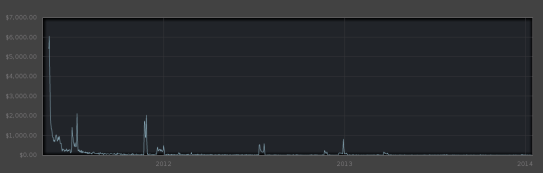
(As you can see in this graph, in 2013, I stopped participating in Steam sales. Oops!)
In 2009, Steam had its first big sale. I'm guessing that they were blown away by how much money they made, because they followed that sale with three more sales the next year. These days, they have 5 gigantic sales each year, which means that a sale is pretty much always just around the corner. And even better, in between the sales, there are publisher sales and weekend sales and deals-of-the-day and so on. Something is always on sale.
On its face, this seems like an obvious win for game developers: they get to revive their dwindling long-tail numbers with a big revenue boost, and a sale will bring more latecomer players into their games too. This also seems like a win for players: people who can't afford to buy a game at full price get a chance to play it later, for cheaper. The audience grows, and more people get to experience the game. Good stuff.
But I suspect that something different is happening. Something that is arguably bad for players, and possibly bad for developers as well.
To put it bluntly: sales screw your fans.
Your fans love your games and eagerly await your next release. They want to get your game as soon as it comes out, at full price. But they are foolish to do that, because a sale is right around the corner. Even in economic terms, the extra utility of playing the game early, at release, is not big enough to offset the extra cost for most people . It makes more sense to wait, unless they love you and your work so much that they're willing to throw economic reason out the window. It's nice to have fans that love your work that much. And these are the fans that you kick in the teeth when you put your game on sale.
But forget the fans for a moment. A culture of rampant sales is a culture of waiting. "I'll buy it later, during a sale." Launch weeks become weak, and developers grow to depend on sales for financial survival. Even in my example from above, 25% is a pretty sad launch week. In my case, that represented something like $23K. I made more selling the game through my own website. Pathetic. Of course, sale after sale, later on, pumped my revenue up to way more than what I made on my website.
This waiting game is likely decimating your player base and critical mass at launch by spreading new players out over time. And your fans, who are silly enough to buy the game at launch and waste money, get to participate in a weaker, smaller player community.
Finally, there's the possibility that the culture of sales actually reduces developer revenue over the long term. If just half of the players who buy the game during a 50%-off sale would have bought the game at full price if that was their only option, we'd already have a wash. What fraction of sale-waiting players fall into this category? I suspect way more than half. The picture gets even worse for 75%-off sales.
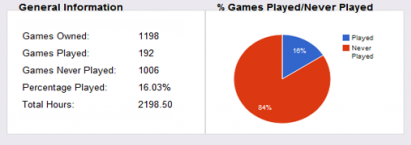
To balance this out, we would need a whole lot of people who will buy random games just because they are on sale---games that they had no intention of buying otherwise. Maybe there are enough of these people, and I've certainly met some of them: people who have a backlog of 50 unplayed games in their Steam library. Maybe they'll never play them. But even if there are enough people doing this, it's not a good thing. It's just people being tricked into wasting money on stuff they don't want or need. Better that they spent that money on one full-price game that they really want rather than four 75%-off impulse buys to add to their backlog.
All that said, I get why a culture of sales has blossomed, and I also get that it's impossible to escape from it now. To Valve's credit, they never force developers to put their games on sale. Of course, when most developers are putting their games on sale, it becomes harder for the remaining developers to make sufficient revenue without joining the sales, which means even more developers will put their game on sale, which means that players will know that pretty much every game will be available at a deep discount sooner or later, which means that more players avoid buying games at full price, and so on.
And to be fair, selling older games at a deep discount isn't something that modern developers invented. It's in our blood from way back:
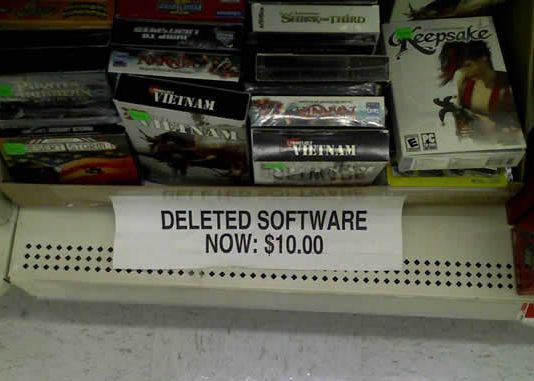
But a bargain rack for physical retail makes perfect sense and is actually pretty great for everyone. Shelf space is limited, as are the number of available copies of a given game, and retailers need to eventually liquidate old games to make room for new ones. But the temptation for players to wait until it's on sale is weaker, because there's a good chance that an awesome game will sell out before it ever hits the bin. Just try finding a copy of Rez, Ico, or Rock Band 3 in the bargain bin. Some games even sell used for more than their original retail price. Other old games are almost impossible to find.
When we're talking about digital games, the potential full-price lifetime is pretty much eternal. There is no shelf space. Even the long tail isn't a hard-and-fast rule anymore. As the game's audience grows, revenue can actually climb over time, sometimes even making launch week look like an insignificant blip. Consider Gary's Mod, which has been selling steadily, at an increasing rate, for seven years:
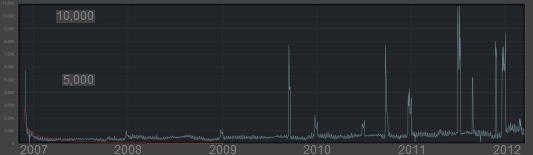
Yes, there are some big, thin spikes there during the sales, but they are insignificant compared to the day-to-day full price volume. And how much thicker would that daily volume be if players weren't waiting for sales?
Okay, but what are the alternatives? More importantly, how am I going to price The Castle Doctrine? If you buy it at launch, are you going to be screwed a few weeks later by a sale? Am I going to make you wish that you waited?
Let's consider the implications of the Minecraft pricing model. What if, instead of inevitable sales as a game ages, the price rises over time instead?
For the fans, this is a great thing, because their die hard fanhood is rewarded with a lower price, almost like a secret deal for those who knew about the game before anyone else. When the price goes up later, they feel smart. Most importantly, they don't feel torn between supporting their favorite developer at launch and saving money. They can do both.
For people who find out about the game later, after the price has gone up a bit, they may regret not buying the game before the increase (a lesson learned for next time), but they can still feel smart buying the game now, before it goes up again.
For the people who buy the game the latest, after the final, permanent price has been reached, they had the chance to wait to hear more about the game before buying. They had less to lose at that point, because the game has been vetted and the community established.
But in general, people who missed lower prices in the past may not even be aware of what they missed. They come to buy the game now, and see the current price now. On the other hand, when your game goes on sale later, everyone who bought it at full price remembers what they paid and feels the sting. Being unaware of what you're missing has a different psychological impact than having what you missed thrown right in your face.
Indeed, people gripe openly when they buy a game only to see it discounted next week. They even email developers and ask for refunds. Who complained when the price of Minecraft went up?
No one, because the Minecraft pricing model also permits total openness about future pricing plans. You can safely announce, "The price will go up next week. This is the last week to get the lower price." This will create a huge revenue spike as people race to get the game---no problem there.
However, if you're planning to put the game on sale next week, you can't announce it, because you will cannibalize this week's full-price revenues. Even worse, people who would decide to wait upon news of a forthcoming sale may forget to come back and buy the game later. They're at your website now, and you can't afford to scare them away now. So, you have to keep the forthcoming sale secret. You have to surprise people. And burn people. The worst case here is pretty awful: the sorry person who buys the game one minute before the surprise sale price kicks in. You're going to get an email from that person.
So, the rising price model is really just an inversion of the sales model. You get revenue spikes later in the life of the game, right before announced price hikes, which are very similar to the spikes induced by putting a game on sale. But there are no surprises, so no one feels screwed by the process.
In the case of The Castle Doctrine, the "ever rising" price model was a perfect fit for other reasons. As a massively-multiplayer server-based game, it required extensive testing before launch. I could reward those early testers with the biggest discount. Also, as a server-based game, each additional "copy" sold is not without cost to me: it's one more player logging into the server, and potentially one more player who will need tech support during an outage. I can't just pepper the ground with cheap or free download codes, because download codes are actually lifetime accounts.
So, here's how it is going to work:
The final price of the game will be $16. During alpha testing, up through launch, the game has a 50% discount for $8. During launch week, the game will have a 25% discount for $12. After launch week, the game will rise to full price.
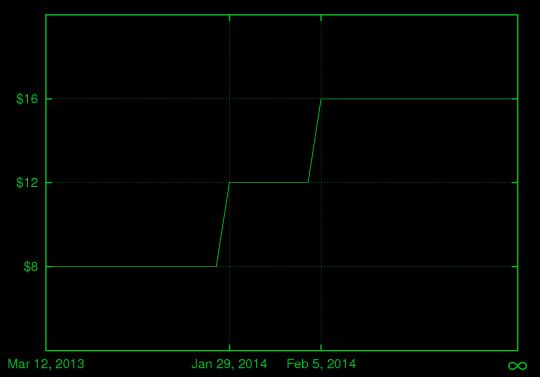
In other words, this is the last two weeks to get the game at 50% off (ending January 28). If you want to wait until launch on Steam, you can get it for 25% off if you buy it during the first week (ending February 4). Otherwise, the game will be full price at $16 forever after that.
Anyone feel burned by that plan?
#370 Re: Main Forum » Visibility issues and Gamma » 2014-01-14 17:35:25
Hmm... well, it's no more of a guessing game than the combo locks with an expensive-to-pass commit gate in front, right?
In this case, we know that a door is only deadly if a dog that has seen you already can walk there. So, not every door is a possibility, and there's room for quite a bit of invention regarding stuff behind the walls to force the dog to go to certain doors but not others. But it's not just "a door" by itself that does this. It takes a lot of stuff behind the door to make it work. So... we can't just compare the cost of bypassing a "deadly door" to the cost of the door.
My point is, it's just another avenue to build a secret knowledge house. Before this change, door couldn't be used as traps at all. It just seems like more variety.
I still don't like the "very hard to see" dogs at the edge of the screen that can see you. I'll fix that somehow.
#371 Re: News » Version 29 Released » 2014-01-14 17:28:26
Well, it depends on how fast they press the keys, right? :-)
And yes, the timer only appears in the last minute. I didn't want to give the whole robbery a tense, timed feel. So, it was kind of a hybrid. Most people don't spend 10 minutes on a robbery, so most will never see the timer.
#372 News » Version 29 Released » 2014-01-14 14:22:00
- jasonrohrer
- Replies: 6
This release further improves the visibility shroud. It also contains loads of little fixes that improve honor-system security between the client and the server and also thwart various potentially harmful player behaviors.
The biggest visible change in this release is the addition of a 10-minute maximum timer for each robbery. You can no longer monopolize a house for hours by robbing it slowly.
A full list of changes can be found here:
#373 Re: Main Forum » Abusing chill timeouts? » 2014-01-13 16:30:55
At least one player has already been using a keyboard bot to camp in a house all night.
The potential for abuse here is obviously endless.
This is also motivating me to put a max timer on robberies. Otherwise, you could grief another player by entering their house and turning on a keyboard bot.... you could block their house forever this way.
#374 Main Forum » Abusing chill timeouts? » 2014-01-13 11:58:07
- jasonrohrer
- Replies: 3
The way the game currently works is this:
--If you die in a house, you have an hour-long chill before you can come back into that house.
--If you bring tools into a house and then die later, somewhere else, you have an hour-long chill before you can come back into that house (with the hour starting at when you entered the house with tools
--If you reach a vault in a house without carrying tools, and then die later, somewhere else, you have an hour-long chill before you can come back into that house (with the hour starting at the time you reached the vault).
--If you reach the vault in a house or kill family members, and the owner of that house dies and respawns, you can't see their new house for an hour.
The chills are there to prevent pounding on one house over and over across multiple suicide lives, and also to prevent tool dumping and build-up from one account to another (buy $2000 worth of stuff, die in your other house, repeat----or buy $2000 worth of tools, die in some house, and then rush back to that house in the next life to claim them).
The force-ignore when an owner respawns is there to prevent one account from respawning over and over to feed starter money to the other account (respawn, rob self for $2000, repeat).
Okay, that's the background. Now a few things to consider:
If you use your second account to "camp" in a house that has a chills or one of these force-ignores, you can prevent other players from accessing it until the timer wears off, and then go in to claim the value yourself.
Example: dump tools into account B using account A. Then camp in house B using account B. Wait an hour. Then leave house B, and return with account A to claim the tools.
In the case of the force-ignore after an owner respawns, it's even worse, because after respawn, the house is unedited, and therefore is eternally off the house list. So, you don't even have to camp. Just don't touch the new house, and wait an hour before editing it and putting it on the list, then nab it with your other account.
Yes, this still takes an hour. But it's still $2000 in free money every hour if you pull it off, with no effort other than watching the clock.
So.... I'm thinking that these timers should probably only "tick" when a given house is visible to other players on the house list. The ticking should stop when ANYONE is in the house (owner or robber). This would prevent this kind of camping.
For chills, this would totally prevent "safe" tool dumping through camping. The house would have to be visible to other players for a full hour before you could come in to get the tools. They'd probably be taken.
For force-ignores, this would mean that you'd need to keep fixing up the house and editing it to keep it on the list for a full hour. With a "starter" throw-away house, it would be robbed by someone else right away and stop ticking.
Essentially, this would remove all utility from "throw away" houses that aren't really playing the game.
The one side-effect of this is that chill times will stop being predictable (because they will now depend on actions of other players and the house owner). Maybe that's a good thing, though.
#375 Re: Main Forum » Maximum number of item types a house can FORCE a robber to use? » 2014-01-13 11:34:08
That is a good idea!
Spawning and killing new servers is really simple, and it's easy enough to pass people a new reflectorURL to put in their settings folder.